
Basic Skills in Laparoscopic Surgery
Laparoscopic Surgery Training Program
An intensive one-month programme at a university hospital in Istanbul, covering the core laparoscopic skills and knowledge essential for every surgical discipline, from instrument handling to suturing, knot tying and complication management.
Duration 1 month · Small group of 1–3 participants
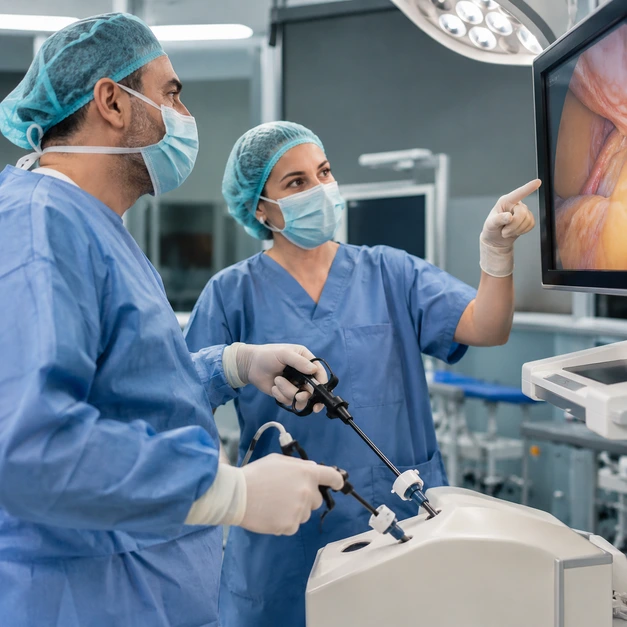
Build the core skills every laparoscopic surgeon needs
The core laparoscopic skills and knowledge essential for every surgical discipline, in one intensive month.
You work with a range of high-quality laparoscopic equipment and specifically designed benchtop models, developing the hand–eye coordination and instrument control that laparoscopic surgery demands. Knotting and suturing techniques are practised step by step until they become routine.
Alongside technical skills, the programme covers laparoscopic anatomy, energy modalities, key operative procedures such as cholecystectomy, appendectomy and perforated ulcer repair, and the prevention and management of complications.
Programme at a Glance
- One-month intensive training
- Small group of 1 to a maximum of 3 participants
- Laparoscopic equipment and purpose-designed benchtop models
- Assessment and official university certificate
What You Will Be Able to Do
After completing the programme, you should be able to:
- Set up a laparoscopic stack, correctly connect the light source and obtain a good-quality image.
- Identify means of access and outline correct patient positioning.
- Discuss and anticipate a range of complications and how to manage them.
- Demonstrate a range of suturing and knot-tying techniques.
- Perform key laparoscopic procedure steps on training models and discuss the role of laparoscopy in diagnosis.
- Evaluate the use of different energy sources.
- Demonstrate broad knowledge of laparoscopic operative procedures, including ulcer repair, appendectomy, cholecystectomy and breast surgery.
Topics Covered
A wide range of foundational and advanced topics in laparoscopic surgery:
- Laparoscopic instrumentation
- Access techniques
- Instrument manipulation
- Dissection and clipping
- Continuous suturing
- Laparoscopic surgical technique
- Laparoscopic anatomy
- Laparoscopic pelvic anatomy
- Energy modalities
- Laparoscopic cholecystectomy
- Appendectomy
- Repair of a perforated ulcer
- Gastrointestinal repair
- Breast surgery
- Cancer staging surgery
- Lymphadenectomy
- Laparoscopy in the obese patient
- Difficult laparoscopic cases
- Complication management
- How to avoid vessel injury
- Trocar-site closure techniques
One Month, Two Stages
The programme moves from essential technical skills to operative knowledge, with practical work on laparoscopic equipment and benchtop models throughout.
Equipment & Basic Techniques
Build confidence with the laparoscopic system and fundamental instrument skills.
- Stack set-up, light source and image quality
- Access techniques and patient positioning
- Instrument handling and manipulation
- Dissection and clipping
- Continuous suturing and knot-tying techniques
- Energy modalities
Procedures & Complications
Apply your skills to key procedures and complex clinical scenarios.
- Cholecystectomy, appendectomy and perforated ulcer repair
- Laparoscopic and pelvic anatomy, gastrointestinal repair
- Cancer staging surgery and lymphadenectomy
- Difficult cases and the obese patient
- Avoiding vessel injury and trocar-site closure
- Complication management and final assessment
Training scope: Practical training is carried out on laparoscopic equipment and purpose-designed benchtop models under the supervision of the surgical faculty. Any participation in clinical activities is determined by the supervising team in line with hospital rules and patient consent.
Small group: 1–3 participants
Places are limited. Apply early to secure your preferred dates.
University Training & Certification
Surgical Faculty
The programme is delivered by experienced surgical faculty of a university hospital in Istanbul, including professors with extensive experience in laparoscopic surgery and surgical education.
- Accredited university
- Supervision by university surgeons
- High-quality laparoscopic training equipment
Official University Certificate
On completion of the programme and its assessment, participants receive an official certificate issued by the university, stating the programme title and training period.
- Issued by the university, not by a private agency
- Awarded on completion of the full programme
- Includes a skills assessment
Programme & Registration
Supervised laparoscopic skills training, assessment and an official certificate issued by the university.
Basic Skills in Laparoscopic Surgery
Small group · 1–3 participants
- One month of training at a university hospital
- Laparoscopic equipment & benchtop models
- Suturing, knot tying, dissection & clipping
- Assessment & official university certificate
The fee covers the training programme only. Travel, accommodation and transfers are arranged by the participant.
Your place is confirmed once your documents are approved and payment is received.
Application Form
Send your details and our team will contact you with available dates and the programme fee.
Frequently Asked Questions
Who is the laparoscopic surgery course for?
How long is the programme and how many participants attend?
Where does the training take place?
Does the course include hands-on practice?
Which procedures are covered?
Will I receive a certificate?
Are accommodation and transfers included?
How do I register?
Ready to build your laparoscopic skills?
Ask us about available dates or apply today. We usually reply within one working day.